Art Heals, Violence Hurts
An arts-based youth project that used creative expression to prevent violence and encourage peaceful coexistence.
Our project was funded and implemented by the European Union and the Spanish National Agency (INJUVE).
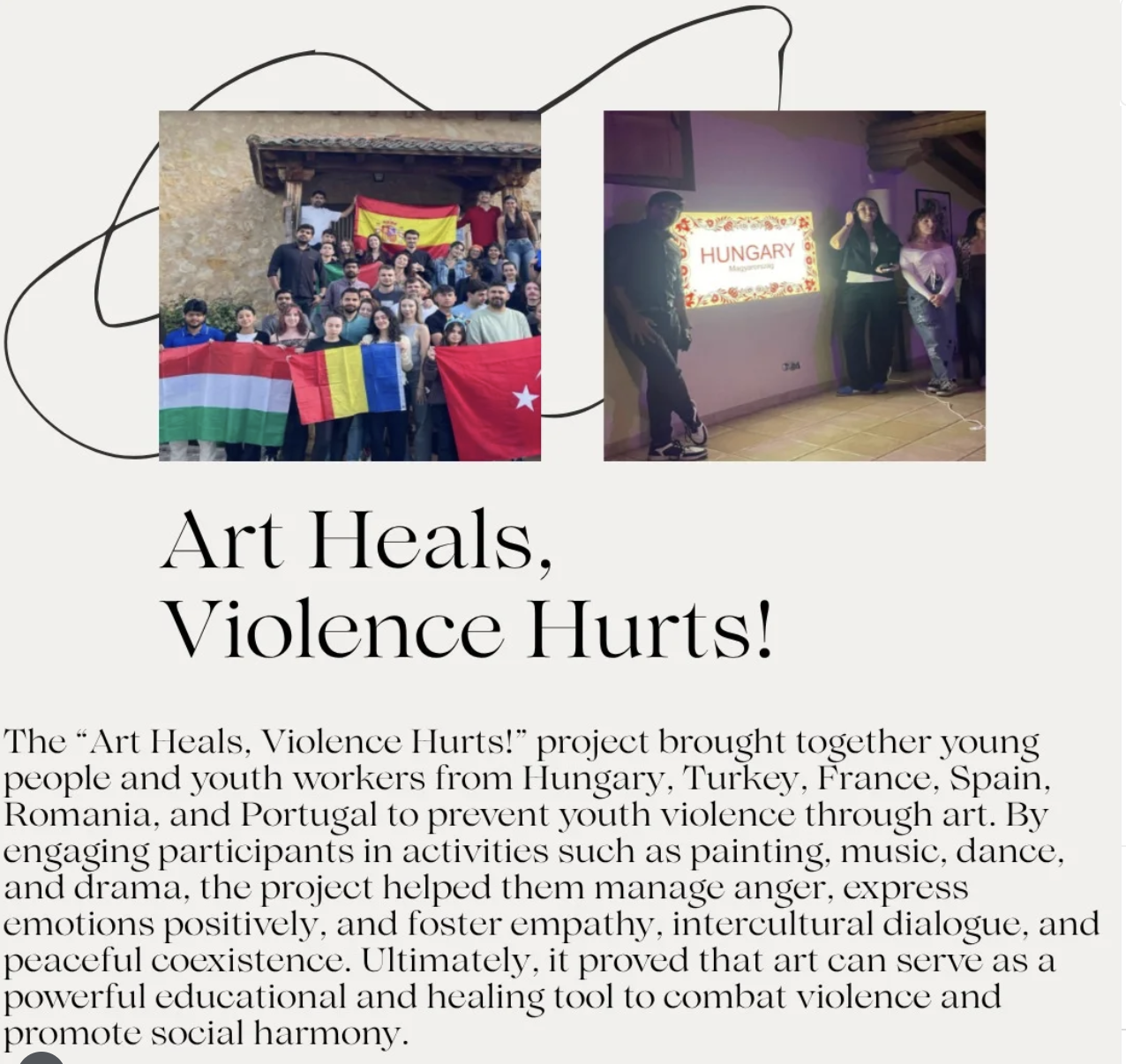
Young people and youth workers from Hungary, Turkey, France, Spain, Romania and Portugal participated in this youth exchange supported by the Spanish National Agency (INJUVE) and the European Union.
Our project aimed to prevent violence among young people through the transformative power of art. Globalisation and mass media have exposed young people to stress, social pressures and negative role models, which has increased their propensity for violence. By integrating art into their daily lives, the project encouraged young participants to express their emotions in constructive ways, manage their anger and reduce their aggression. Artistic activities such as painting, drama, music and dance provided young people with safe spaces to explore their creativity, strengthen their self-confidence and replace violent impulses with peaceful expression. In this context, art served as both a preventative and a healing tool.
The overall aim of the project was to use art as a tool to reduce young people’s propensity for violence. Its specific objectives were to highlight the causes and consequences of violence, share best practices among stakeholders, leverage the calming and healing effects of artistic activities, raise awareness about anger management, and demonstrate how art can enhance happiness and social cohesion. The project also aimed to foster long-term collaboration among stakeholders in combating youth violence.
During the activities, participants aged 16–25, including disadvantaged youth and group leaders, took an active role. They joined icebreaker games, expectation-sharing sessions and Youthpass presentations. Expert-led workshops on “The Role of Art in Violence Prevention” were held, including abstract painting sessions and creative drama. Participants prepared brochures, implemented anger management challenges and carried out fieldwork, sharing materials with local communities. Museum visits were combined with sculpture workshops, linking artistic observation with practical creation. Country-specific presentations and social experiments enabled participants to analyse the roots of violence in their own communities. In the following days, dance choreographies, theatre performances and interviews with local residents further connected the themes of art, peace and youth expression. Cultural nights, energisers and daily evaluations strengthened group cohesion, while leadership meetings supported coordination. The final day was dedicated to project brainstorming, preparing newsletters and planning dissemination strategies for sustainability.
The expected results were achieved at both individual and community levels. Participants increased their awareness of violence, learned non-violent conflict resolution methods and discovered the role of art in reducing stress. They also developed competences in self-expression, teamwork, intercultural communication and creative problem-solving. At the community level, dissemination of project results through brochures, performances and social experiments raised awareness of the importance of art for peace.
When participants returned home, they were motivated to integrate art into their schools, youth centres and local initiatives, and long-term effects were observed. They increased the impact of the project by sharing their knowledge and experiences with their peers. Intercultural dialogue and tolerance were encouraged, prejudices were reduced and a more peaceful attitude towards diversity was adopted. Participants were also encouraged to adopt environmentally friendly habits such as green travel and low-carbon activities, linking social peace with sustainability. Partner institutions established new collaborations and strengthened European networks, ensuring the continued circulation of the knowledge and best practices developed in the project.
Ultimately, the project demonstrated that art is not only a creative tool but also a practical and effective means of preventing violence, fostering empathy and building peaceful communities. By combining education, creativity and intercultural exchange, the project successfully provided young people with new perspectives on dealing with conflict and promoting a culture of peace.