Beyond the Stage: Creative Pathways to Empower Youth Workers
A training programme using art-based methods to empower youth workers and promote inclusion among marginalized youth.
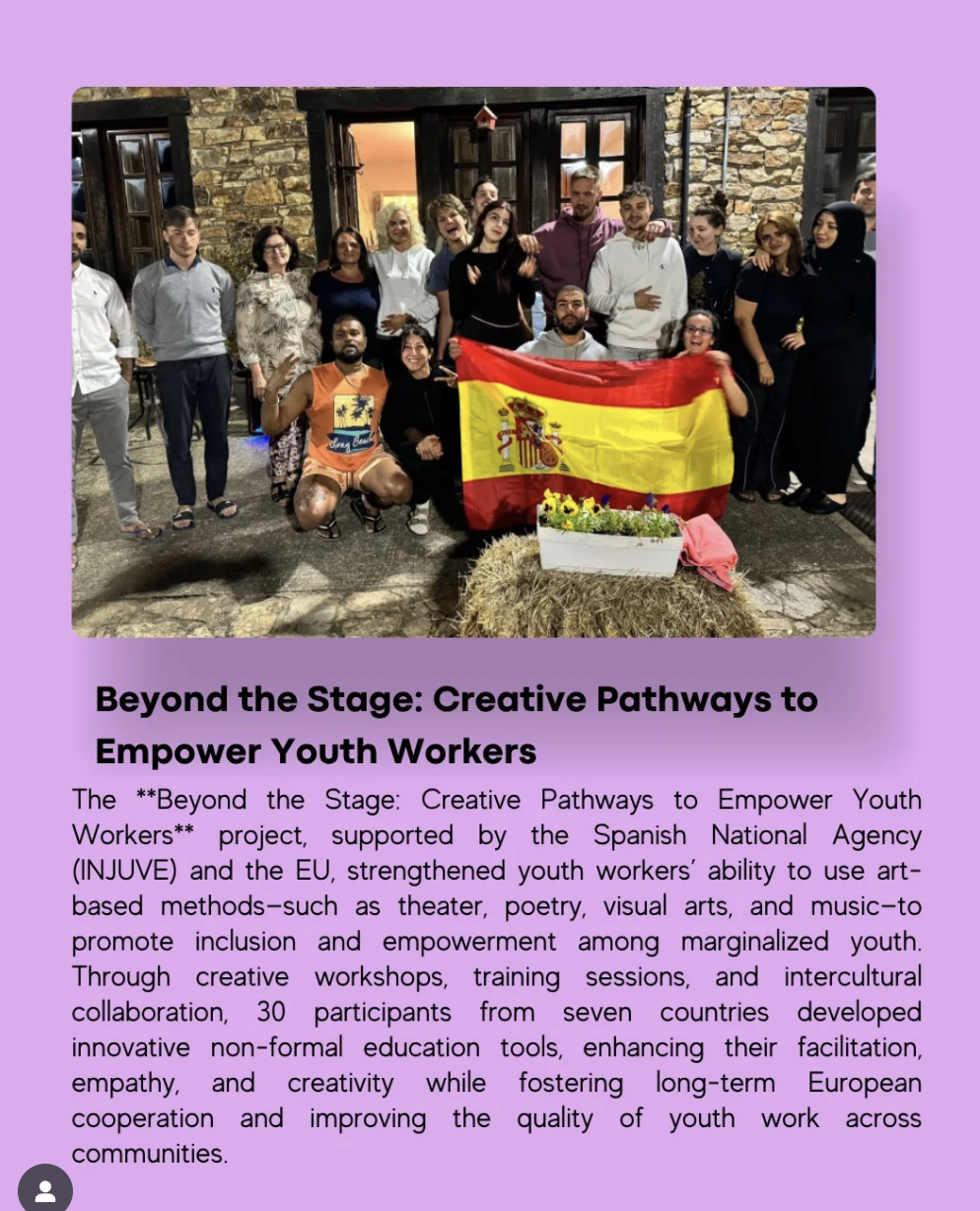
Young people and youth workers participated in this youth project supported by the Spanish National Agency (INJUVE) and the European Union.
The project,
Beyond the Stage: Creative Pathways to Empower Youth Workers,
aimed to enhance the capacity of youth workers to use creative and artistic methods to promote inclusion, empowerment and social participation among young people, particularly those from marginalized or disadvantaged backgrounds.
Its objectives focused on equipping youth workers with innovative tools to improve their practice through non-formal education methods such as theatre, poetry, visual arts and music. The project empowered youth workers to create safe and inclusive spaces for self-expression, enabling young people to explore their identities, share their concerns and take active roles in their communities. It also strengthened youth workers’ capacity to engage with young people facing discrimination, social or geographical barriers, fostering intercultural dialogue and encouraging participation in democratic and cultural life.
A further objective was to develop non-formal educational tools incorporating artistic approaches, providing youth workers with adaptable methods for diverse contexts and challenges. The project also promoted personal and professional growth by enhancing creativity, communication, facilitation, critical thinking and reflective practice. Moreover, it encouraged cross-cultural collaboration and the exchange of best practices, contributing to stronger international cooperation in the youth field. Another important aim was to support the recognition and professionalisation of youth work at local, national and European levels by validating competences and providing concrete learning outcomes. Ultimately, the project improved the quality of youth work by equipping participants with new skills and methods transferable to their daily practice.
The main activities included interactive workshops, training sessions, artistic performances, group discussions, reflection exercises and collaborative project design. Sessions focused on using theatre, poetry, visual arts and music as tools for social inclusion, giving participants practical experience in facilitating such workshops. Training activities introduced non-formal educational techniques integrated with creative arts, including case studies and collaborative exercises.
Participants also presented artistic performances—such as theatre pieces, poetry recitals and visual art installations—that demonstrated the practical application of these methods. Structured reflection and peer feedback enhanced learning, while group projects addressed issues of inclusion and empowerment to be adapted in participants’ home organisations. Intercultural dialogue and diversity activities promoted inclusivity across cultural contexts, and networking sessions laid the foundation for sustainable international partnerships.
The project involved 28 youth workers from seven countries—Spain, France, Romania, Türkiye, Slovakia, Portugal and Ukraine—alongside trainers, bringing the total to 30 participants. They were aged between 25 and 45 and represented a wide professional spectrum including youth workers, social educators, art educators, cultural mediators, NGO staff, mentors and volunteers working with marginalised youth. The selection process ensured balanced representation from each partner, prioritising experience, motivation and potential to apply outcomes in local contexts.
The project produced significant results. Youth workers gained concrete skills in creative and artistic methods for inclusion, improved their facilitation and leadership capacities and developed stronger intercultural and empathetic approaches to youth work. They experienced professional renewal and increased motivation, positively impacting the young people they serve.
Organisations benefited from enhanced capacity to design and implement creative and inclusive youth programmes, raising the overall quality and innovation of their practices. International partnerships were strengthened, laying the groundwork for future cooperation.
Wider communities also benefited, as youth programmes became more inclusive and creative, increasing young people’s engagement and reducing social isolation. At national and European levels, the project contributed to advancing non-formal education practices by promoting arts-based approaches and reaffirming the value of creativity as a tool for social inclusion.
By disseminating the toolkit and methods developed, the project ensured long-term sustainability. Its impact extended beyond the immediate participants, creating ripple effects across organisations, local communities and the broader field of youth work in Europe. Ultimately, disadvantaged young people emerged as the main beneficiaries, gaining confidence, self-expression and a sense of belonging through the empowered and innovative practices of the youth workers involved.