Mindfulness vs Autism
A capacity-building programme integrating mindfulness and yoga-based methods to support young people with Autism Spectrum Disorder.
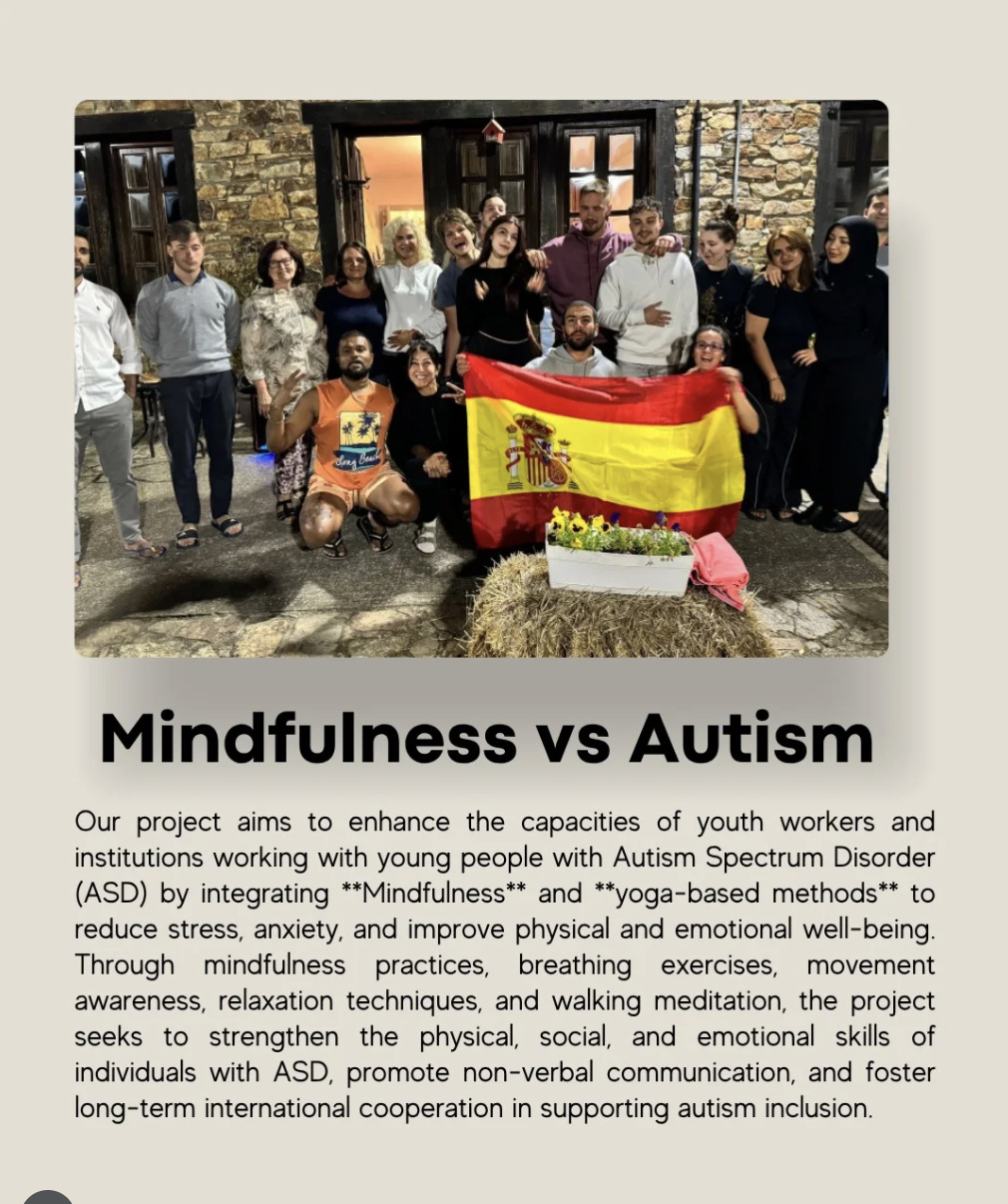
Our project was funded and implemented by the European Union and the Spanish National Agency (INJUVE).
Studies show that one in 68 children are susceptible to developing Autism Spectrum Disorder (ASD) (Baio, 2018), and this rate seems to be increasing every day. Historically, in 1985, 1 in 2,500 children were diagnosed; in 2000, 1 in 150; and in 2008, 1 in 88. Today, it is thought that 1 in 68 children is born at risk of autism.
Many people with ASD experience chronic stress and anxiety. Studies have found that adults with ASD have three times the level of anxiety compared to adults with intellectual disabilities. It has been observed that the higher the levels of anxiety and stress in adults with ASD, the lower their ability to cope with change, strong sensory stimuli and unpleasant events.
There is evidence that mindfulness training contributes to stress reduction, resulting in positive changes in people with ASD and their families. The practice of mindfulness has a strong relevance to modern psychology. Hassed and Chambers argue that mindfulness is “a mental discipline aimed at training attention.”
Thus, mindfulness turns out to be a scientifically supported practice that yields positive results in hospitals in many parts of the world today. Looking at the results of MBSR therapy applied in hospitals by Jon Kabat-Zinn (Cachia, Renée L., “Mindfulness and Autism Spectrum Disorder”), a decrease has been found in psychological distress, anxiety, depression, anger, rumination, cognitive dysfunction, post-traumatic avoidance symptoms and medical symptoms.
People with autism (ASD) tend to have weaker muscle strength and endurance than their peers. Therefore, many of them lack some of the physical abilities that others possess, including balance, coordination, visual-motor control and other mobility skills. In our project, yoga postures and “walking meditation” activities, applied through imagination and storytelling and based on mindfulness principles, aim both to reduce the anxiety levels of people with autism and to support and strengthen their physical competence.
In this project, aspects such as meditation, breathing exercises, deep relaxation techniques, activities that strengthen and develop body and inner awareness, and yoga postures narrated with images will be developed in line with mindfulness principles and practiced with people with Autism Spectrum Disorder (ASD). In addition, all this work will be shared with the youth workers of the project. Later on, new activities and practices will be created together. To achieve our goals, we will first introduce youth workers to what mindfulness is and some of its basic concepts, and we will share mindfulness meditations and informal practices that they can use in their daily lives. By developing their competence and motivation to apply mindfulness regularly, these practices can become lifelong habits.
In this context, the main purpose of our project is to increase the capacity of institutions working with young people with Autism Spectrum Disorder to develop their physical and socio-emotional skills, including non-verbal communication and relationship-building skills. To achieve this goal, various activities such as mindfulness, breathing awareness, movement awareness, different deep relaxation techniques, practicing physical yoga postures with imaginary stories and walking meditation will be carried out. All these techniques will be taught to and practiced with youth workers.
Our specific objectives are:
- To increase participants’ knowledge about the problems experienced by people with autism in different countries and to reflect on possible solutions.
- To teach mindfulness, breathing awareness, movement awareness, deep relaxation techniques and yoga postures, so that they can be applied with young people with Autism Spectrum Disorder.
- To carry out activities that reduce the stress and anxiety levels of young people with Autism Spectrum Disorder.
- To develop long-term collaborations between partner institutions in order to address the problems of young people with Autism Spectrum Disorder.