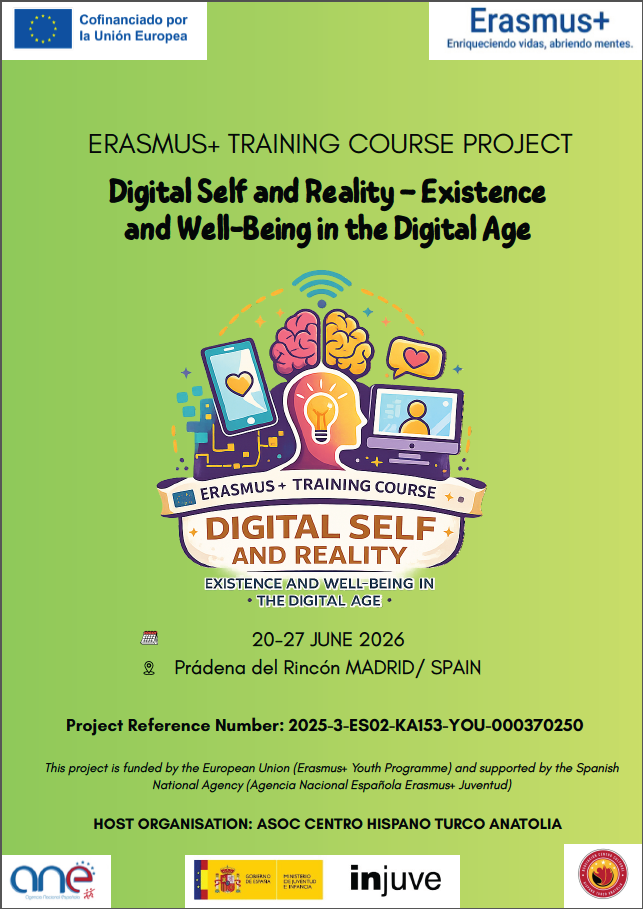
Digital Self and Reality – Existence and Well-Being in the Digital Age (DIGISELF) Project Acronym: DIGISELF
Digital Self and Reality – Existence and Well-Being in the Digital Age (DIGISELF) is an Erasmus+ KA153 Youth Workers’ Mobility project coordinated by ASOC (Spain) alongside partners from Turkey, Estonia, Hungary, Bulgaria, Ukraine, and the Netherlands. Bringing together 34 youth workers and leaders in Madrid, DIGISELF addresses digital burnout, online identity pressure, and mental health. Through interactive workshops, digital detox simulations, media literacy labs, and collaborative content creation, the project equips youth workers with practical non-formal learning tools to foster healthy digital habits and reach over 600 young people across Europe.
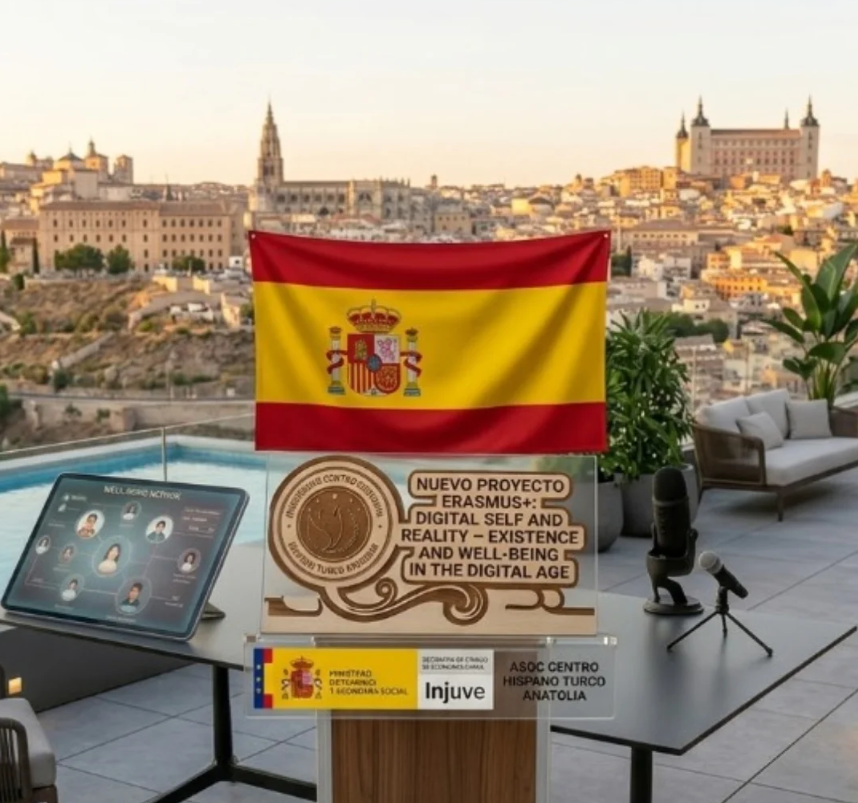
Action Type: KA153-YOU – Mobility of Youth Workers
Grant / Project Status: Project Ongoing
Project Duration: 8 Months (Start Date: February 20)
Mobility Activity Dates: July 11–18, 2026 (6 full working days + 2 travel days)
Applicant / Host Organization: ASOC (Spain – Coordinator)
Partner Institutions: Gazi University (Turkey), Kastamonu University (Turkey), Estonia, Hungary, Bulgaria, Ukraine, Netherlands
Participant Profile: A total of 34 participants across 6 partner countries and 7 institutions/NGOs (4 youth participants per country aged 20+, 1 Trainer from Turkey, and 1 Facilitator from Spain). Each national team includes at least one participant from a disadvantaged background (economic obstacles, geographical isolation, or fewer social opportunities).
Project Rationale & Background
In today’s hyper-connected world, young people—especially those from disadvantaged backgrounds—face growing challenges regarding online identity curation, mental well-being, and digital burnout. Simultaneously, youth workers urgently need fresh pedagogical tools, innovative non-formal learning methods, and stronger international networks to address digital balance and online mental health effectively.
DIGISELF establishes an international learning environment where youth workers and young leaders explore the tension between their digital and offline selves. By blending critical media literacy, emotional well-being practices, and non-formal educational tools (blogs, podcasts, short film production), the project empowers participants to build healthy digital habits while strengthening their inclusion, intercultural dialogue, and leadership competences.
Key Objectives
-
Empowerment & Digital Well-being: Equip youth workers and young participants with leadership, critical thinking, emotional resilience, and digital balance strategies.
-
Non-Formal Learning & Media Literacy: Train participants in analyzing digital algorithms, combating online manipulation, and co-creating digital balance tools.
-
Inclusion of Disadvantaged Youth: Provide equal access and meaningful roles for participants facing social, economic, or geographical barriers.
-
Institutional Capacity Building: Share best practices and integrate digital tools (video production, blogging, podcasts) into daily youth work practices.
-
Youthpass & Competence Recognition: Embed Youthpass into daily reflection to help participants articulate, document, and transfer their learning outcomes.
-
Wide Dissemination & Networking: Reach at least 600 young people and 30 institutions through local workshops, peer-to-peer sessions, and online platforms while establishing long-term European partnerships.
Activity Highlights (6-Day Mobility Program Framework)
-
Day 1 | Identity & Footprint: Group building, Youthpass introduction, “My Digital Footprint” workshop, and “Digital Self on Stage” creative drama performance contrasting online vs. offline identities.
-
Day 2 | Digital Habits & Critical Reflection: “Digital Diary” tracking, device-free Digital Detox Simulation, analysis of The Social Dilemma, and drafting a collective “Digital Manifesto”.
-
Day 3 | Mental Health & Emotional Resilience: “Stress Radar” mapping, mindfulness exercises, drama workshops on online triggers, and building a practical “Digital Well-being Box”.
-
Day 4 | Media Literacy & Fact-Checking: “Information or Manipulation?” fact-checking challenge, filter bubble debates, social media account analysis, and a mini-video production workshop.
-
Day 5 | Digital Sustainability & E-Waste: Calculating digital carbon footprints (“Invisible Footprint”), researching electronic waste (“E-Waste Detectives”), drafting personal Digital Detox Plans, and creating “Message to the Future” time-capsule letters.
-
Day 6 | Evaluation, Transfer & Sustainability: Participant-led mini-workshops for local implementation, skills harvest exercise, Kahoot evaluation, Youthpass ceremony, and sustainable network building.
Expected Results & Impact
-
Individual Level: Enhanced self-confidence, emotional intelligence, media literacy, and actionable strategies for digital well-being among 34 participating youth workers and leaders.
-
Tangible Outputs: A co-created Digital Well-being Manifesto, awareness videos, podcasts, blog posts, and a digital toolkit for youth organizations.
-
Organizational Level: Capacity expansion for ASOC and partner universities/NGOs, embedding innovative media literacy and well-being modules into daily youth work.
-
Community & European Level: Local multiplier events reaching over 600 young people and 30 organizations, promoting digital balance, inclusion, and European solidarity.